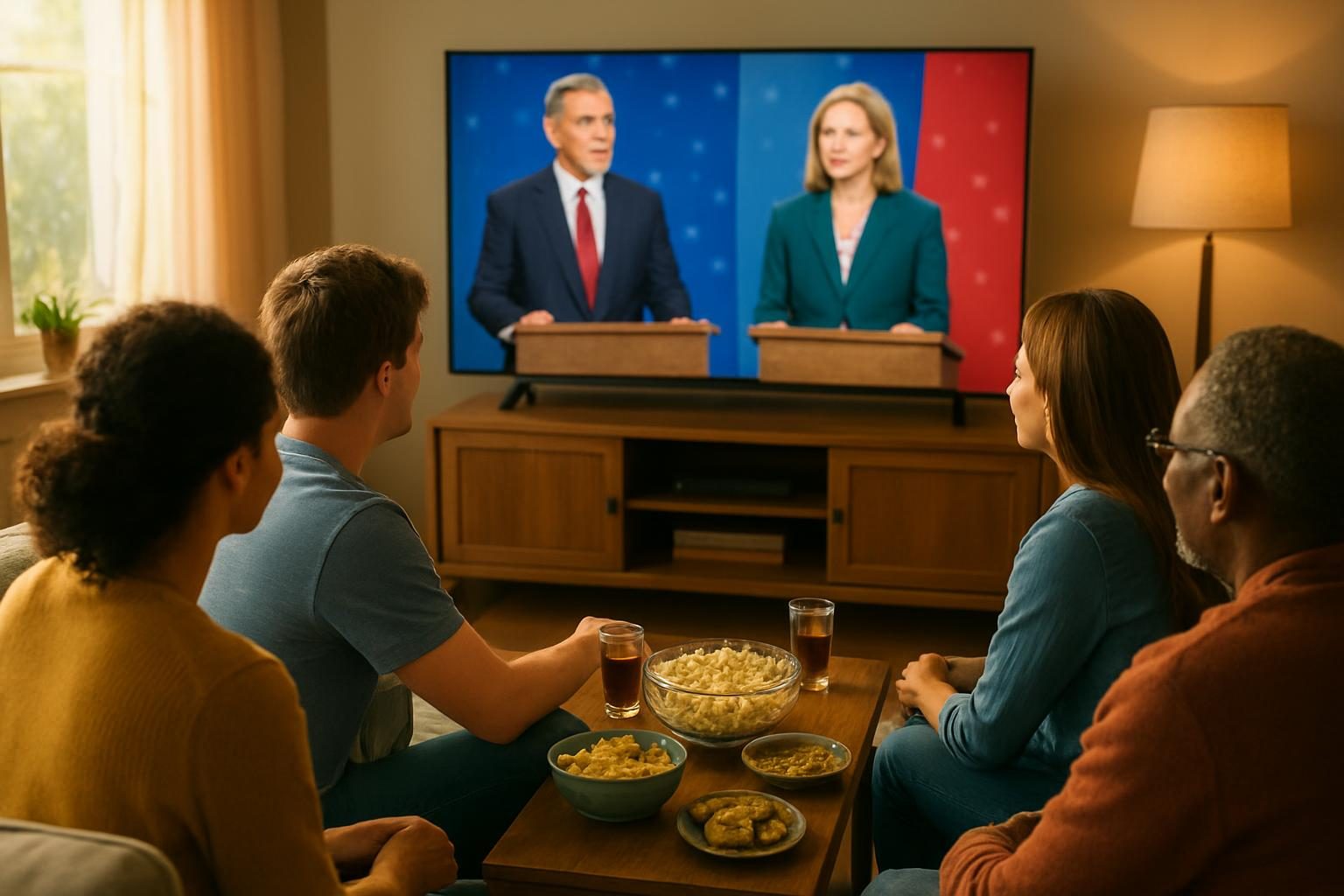
Few moments in a campaign put the candidates side by side, unfiltered, in front of millions of people. Presidential debates are your chance to see how the people asking for your vote think, respond and handle pressure. Here is how to watch presidential debates, how they work, and how to turn watching into action.
Quick answer: Presidential debates are televised, moderated events where candidates answer questions and respond to each other. Most are carried live on broadcast and cable news and streamed free online. No 2028 debate dates have been announced yet; we will update this page when they are.
What a presidential debate actually is
A presidential debate is a structured, live event. Candidates stand at podiums, answer questions from one or more moderators, and respond to each other within set time limits. The goal is to help voters compare candidates on the issues, not to hand anyone a victory by default.
Debates happen at two stages. During the primaries, candidates from the same party compete to become their party’s nominee. In the general election, the nominees of different parties face off. Both matter, and both are worth your time.
Primary debates vs. general election debates
| Feature | Primary debates | General election debates |
|---|---|---|
| Who is on stage | Candidates from one party | Nominees from different parties |
| Main goal | Choose a party nominee | Help voters choose a president |
| Who sets the rules | The party and the hosting media outlet | The sponsoring organization and the campaigns |
| Typical timing | Before and during the primary season | Late in the campaign, ahead of Election Day |
| Stage size | Can be large, depending on the field | Usually the major nominees |
Because the 2028 Democratic field has not formed yet, there is nothing to schedule for primary debates. Our 2028 Democratic candidates tracker follows the people who might run, and none of them has formally declared.
A debate is the one campaign moment where candidates cannot hide behind a perfectly edited ad.
Are 2028 debate dates set?
No. As of this update, we have not seen official 2028 debate dates, hosts or locations announced. We are not going to guess, and you should be skeptical of any site that gives you exact dates this early.
Here is what we do know about the calendar. The general election is Tuesday, November 7, 2028. The DNC approved its early primary window on August 15, 2026, with South Carolina going first on January 22, 2028, and Super Tuesday landing on March 7, 2028. Debates will be built around that timeline, but the debate schedule itself is still being set. For the full picture, see our 2028 Democratic primary calendar.
The Republican side is also unsettled. Republicans are expected to keep Iowa first on their calendar, but their calendar is not final. No Democrat or Republican has formally declared a 2028 run, so there is no official field to debate yet.

How to watch presidential debates
The good news is that watching is easy and usually free. Here is a simple approach that works for most people.
- Find out who is hosting. The hosting network or organization announces the channel, streaming options and start time. Check that announcement once a debate is scheduled.
- Pick your screen. Many debates air on broadcast and cable news and stream free on news outlet websites and apps. Pick whichever setup works best for you.
- Save the time. Put the start time in your calendar and set a reminder. Debates run on a fixed schedule, so being early beats being late.
- Prepare a notepad. Jot down the issues you care about most before it starts. It makes it easier to listen for real answers.
- Watch with someone. Debates are better shared. Invite a friend, a neighbor or your family.
If you miss it live
Full debates are typically posted online afterward, so you can catch up on your schedule. Watching the whole thing beats relying on a few clipped moments, since short clips can leave out the context.
How to get the most out of a debate
Debates move fast. It helps to watch with a plan so you leave knowing more than you did when you started.
- Listen for specifics. Does a candidate describe what they would actually do, how it would work and who it would help?
- Notice what goes unanswered. If a question gets dodged, that tells you something too.
- Check claims afterward. Candidates sometimes stretch the truth. Look up a statement from a reliable source before you share it.
- Compare records, not just performances. A sharp one-liner is memorable, but a candidate’s record and plans matter more.
Want a head start on the policy side? Our guide to where Democrats stand on the issues is a good place to begin before the first debate.
The best debate viewers listen for specifics, not slogans, and they check the claims afterward.

Where debates fit in the road to 2028
Debates are one stop on a long road. Before anyone takes the stage, there is the quiet stretch we call the invisible primary, when potential candidates build donor lists, travel and test their messages. Learn more in when 2028 presidential campaigns start.
From there, primaries and caucuses begin. Our explainer on how presidential primaries work walks through the process, and the 2028 Democratic National Convention page covers the August 7-10, 2028 event. The finalist host cities are Boston, Denver and Philadelphia, and the final pick is expected later in 2026.
After the conventions, the general election campaign takes off. Debates matter most in states where the race is close, so it also helps to know the 2028 swing states and how the Electoral College works, since 270 of 538 electoral votes win the presidency.
The road ends with Inauguration Day on January 20, 2029. If you are curious how that day works, we are preparing a guide to what happens on Inauguration Day 2029.
Why debates matter to progressive voters
In our view, debates are one of the best chances for voters to hear directly from candidates about healthcare, wages, housing, climate, voting rights and the economy. Those are the issues that shape everyday life, and the stage is where candidates have to explain their plans out loud, without a script.
That is also an opportunity. When you watch, talk about it. Ask your friends and family what they heard and what questions they still have. Informed conversations are how movements grow.
Debates are not the whole story, though. Candidates win and lose on records, organizing and turnout. A great night on stage does not matter if people are not registered and ready to vote.

Turn watching into voting
Here is the part that matters most. Watching a debate is great, but showing up on Election Day is what counts. The 2026 midterms are on Tuesday, November 3, 2026, and they set the stage for 2028. See what is at stake in our 2026 midterm elections guide.
Registration rules vary by state, and some states offer same-day registration, though the details differ. North Dakota has no voter registration at all. For your state’s official rules, deadlines and online registration, go to vote.gov or your state election office. Our how to register to vote guide can walk you through the basics.
Take action: Check your voter registration status today at vote.gov or your state election office, then text one friend and invite them to do the same. Next time a debate is announced, plan a watch night together.
Key facts to keep handy
- 2026 midterm elections: Tuesday, November 3, 2026.
- 2028 general election: Tuesday, November 7, 2028.
- Electors meet December 18, 2028, and the inauguration is January 20, 2029.
- 2028 debate dates: not announced yet.
For a full timeline, see our 2028 election key dates page, or head to the 2028 presidential election hub for the big picture.
Key takeaways
- Presidential debates are moderated, live events where candidates answer questions and respond to each other, in both primaries and the general election.
- No 2028 debate dates, hosts or locations have been announced yet, and we will update this page when they are.
- Most debates are carried on broadcast and cable news and streamed online; check the host’s announcement for details.
- Listen for specifics, check claims afterward and compare records, not just performances.
- Watching is just the start. Confirm your registration at vote.gov or your state election office.
Last updated October 2026. Dates and candidate news change fast; we update this page as things are announced.
Frequently asked questions
Have the 2028 presidential debate dates been announced?
No. As of this update, we have not seen official 2028 debate dates, hosts or locations announced, and we will not guess. Primary debate schedules are set by the parties and the general election schedule is typically set well before the fall. We will update this page as soon as real dates are confirmed.
Where can I watch presidential debates?
Major debates are usually carried live by broadcast and cable news networks and streamed free online by many news outlets. Exact channels and platforms depend on who hosts each debate, and those details are not set for 2028 yet. Check the host organization’s announcement closer to the date.
Do I need to be registered to vote to watch a debate?
No. Anyone can watch a debate. But watching is only the first step, since your voice counts most on Election Day. Check your registration status and find your state’s rules at vote.gov or your state election office.
Who gets to be on the debate stage?
It depends on the debate. In primaries, the party and the hosting network set the qualifying rules, which often involve factors like polling or fundraising. For the general election, the sponsoring organization sets the criteria. Since 2028 rules have not been announced, treat any early claims about who qualifies with caution.
Are there debates between the vice presidential candidates too?
Vice presidential debates have been a regular part of general election campaigns in modern history. Whether and when one happens in 2028 depends on the nominees and the sponsoring organization, and nothing has been announced yet.