
Every presidential election comes down to a map, and the 2028 electoral map is already taking shape. A handful of states will decide who sits in the Oval Office on January 20, 2029, and voters in those places have outsized power. The good news: that power is yours to use, and there is plenty of time to get ready.
Quick answer: The 2028 electoral map has 538 electoral votes, and a candidate needs 270 to win. The general election is Tuesday, November 7, 2028. The battlegrounds are not officially set, but the states that decided close races in recent cycles (Arizona, Georgia, Michigan, Nevada, Pennsylvania, and Wisconsin) are the ones to watch. Make sure you are registered through vote.gov or your state election office.
How the 2028 electoral map works
Americans do not vote directly for president. We vote for slates of electors, and those electors make up the Electoral College. There are 538 electoral votes in all, and the winner needs 270 to take the presidency.
Most states award all of their electoral votes to the candidate who wins the state’s popular vote. That is why campaigns pour time and money into a few competitive states and mostly skip the rest. If you want the full explainer, see our upcoming guide on how the Electoral College works.
One technical detail matters for 2028: the election uses the electoral map from the 2020 census apportionment. That means each state’s number of electors is already set, so the fight is about who wins each state, not how many votes it carries.
The key dates on the calendar
| Event | Date |
|---|---|
| 2026 midterm elections | Tuesday, November 3, 2026 |
| General election | Tuesday, November 7, 2028 |
| Electors meet | December 18, 2028 |
| Inauguration | January 20, 2029 |
Want the full run-up? Our 2028 election key dates calendar walks through everything from now to inauguration, and our guide on when the 2028 presidential election is covers the basics.
A presidential race is decided state by state, and your state may matter more than you think.

Battleground states to watch in 2028
Here is an important note on honesty: no one can responsibly hand you a final list of 2028 battlegrounds this early. Candidates have not declared, the issues will shift, and the national mood will move between now and Election Day. What we can do is point to the states that proved most competitive in recent cycles. We are not citing polling here, because it is far too early for polling to tell us anything reliable about 2028.
The Great Lakes trio: Michigan, Pennsylvania, Wisconsin
These three states have been central to presidential contests in recent cycles, and they are often discussed together because of their shared industrial roots and tight margins. Winning the presidency has frequently run through at least one of them. Michigan is also a big deal on the Democratic side: it sits in the DNC’s early primary window, with its primary set for February 22, 2028.
Pennsylvania has a Democratic governor who is widely reported as a potential 2028 candidate, and so does Michigan. We cover each of them in our tracker, and you can read more on Josh Shapiro’s 2028 prospects.
The Sun Belt: Arizona, Georgia, Nevada
The Sun Belt has become a major part of the conversation as these states have grown and changed. Arizona and Georgia each have Democratic senators who are widely reported as potential 2028 candidates, which tells you how much attention both parties are paying to the region.
Nevada is a double story. It is a general election battleground and an early Democratic primary state, with its primary on February 1, 2028. Candidates who want to win the nomination and the White House will spend serious time there.
Other states that could surprise
Every cycle brings a few surprises. States that look safe for one party can tighten when the national environment shifts, and states we call battlegrounds today can drift. We will keep updating this page as the field and the issues come into focus. For a deeper look, watch for our upcoming guide to 2028 swing states.
Why the early primary calendar matters for the map
The Democratic nomination fight and the general election map are connected. Candidates build organizations, test messages, and earn media attention in the early states, and those same skills carry into November.
On August 15, 2026, the DNC approved the 2028 early-window calendar at its summer meeting in Austin, Texas. Here is the schedule:
- South Carolina: January 22, 2028
- Nevada: February 1, 2028
- New Hampshire: February 8, 2028
- New Mexico: February 15, 2028
- Michigan: February 22, 2028
- Virginia: February 29, 2028
Super Tuesday follows on March 7, 2028. Iowa is not part of the Democratic early window; you can read why in our Iowa caucus 2028 explainer. For every date in one place, see our 2028 Democratic primary calendar, and for the opening contest, our page on the South Carolina Democratic primary.
A caution on New Hampshire: state law requires it to hold the first primary in the nation, and that clashed with the DNC calendar in 2024. Watch for changes to the schedule. On the Republican side, Iowa is expected to stay first on the 2028 calendar according to September 2026 reports, but the GOP calendar is not final. To understand the mechanics, see our upcoming explainer on how presidential primaries and caucuses work.
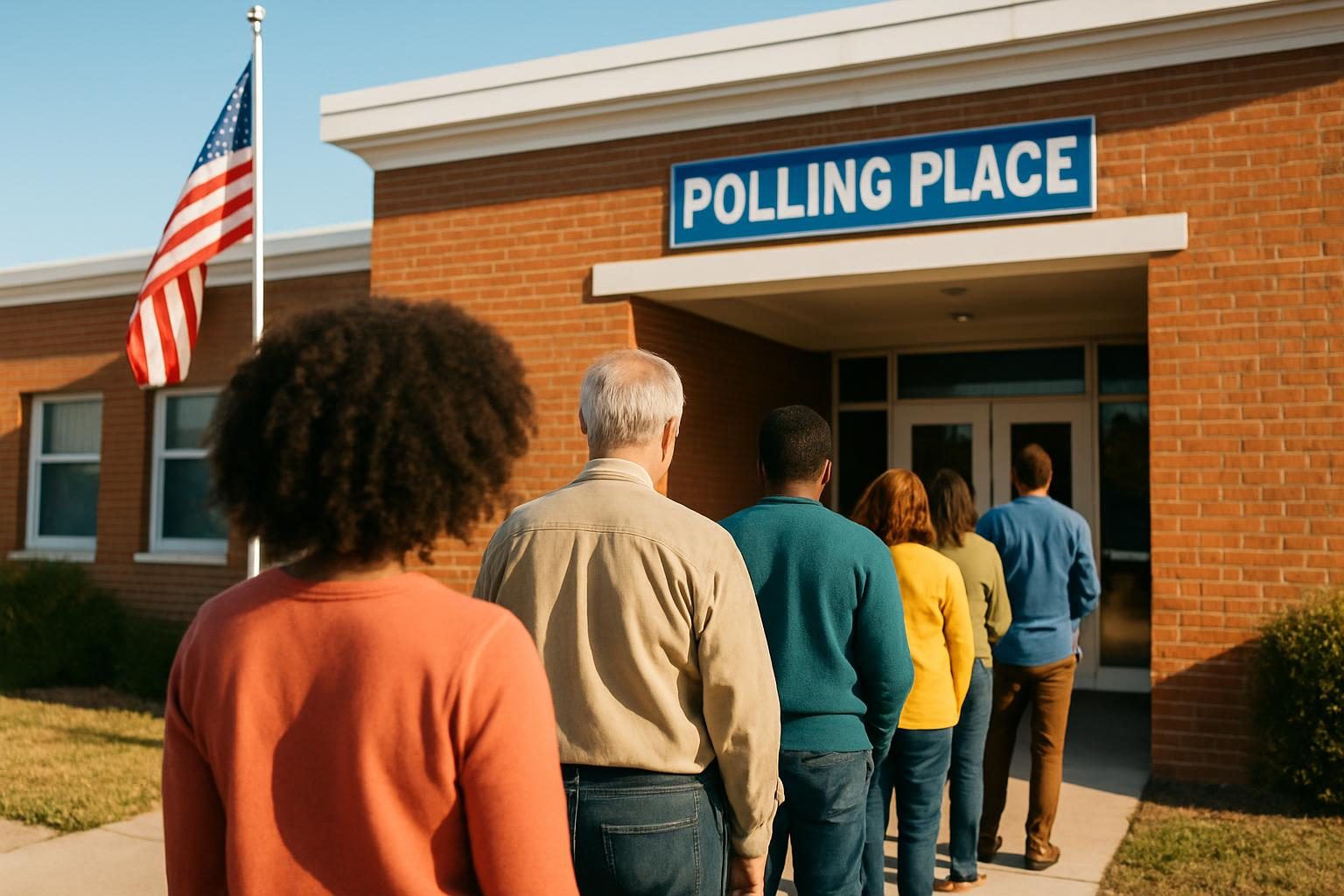
Primaries pick the candidate; the map decides whether that candidate wins. Both are won by people who show up.
Who might run? The candidate picture
As of October 5, 2026, no major Democrat has formally declared a 2028 presidential run. That is normal this far out, and it means the field is wide open. Candidates are not announced yet, and we will update this page when they are.
Widely reported potential Democratic candidates include Gavin Newsom, Josh Shapiro, JB Pritzker, Gretchen Whitmer, Andy Beshear, Pete Buttigieg, Kamala Harris, Alexandria Ocasio-Cortez, Cory Booker, Raphael Warnock, Ruben Gallego, Mark Kelly, Elissa Slotkin, Chris Van Hollen, and Ro Khanna. These are potential candidates only, not announced ones.
Notice how many of them come from or represent battleground states. That is not an accident, and it is part of why the map matters so much to the primary conversation. Explore the full field in our 2028 Democratic candidates tracker, or read about individual names like Gavin Newsom, Pete Buttigieg, Kamala Harris, and Alexandria Ocasio-Cortez.
On the Republican side, no one has declared either. Potential candidates reported include JD Vance, Marco Rubio, Ron DeSantis, Ted Cruz, and Brian Kemp. Curious about eligibility? The Constitution requires a president to be a natural-born citizen, at least 35 years old, and a US resident for 14 years, and the 22nd Amendment limits a president to two elected terms. Read more in Can Trump run for a third term? or see our upcoming guide on presidential eligibility requirements.
The road to the map starts in 2026
Here is our view, and we are labeling it as opinion: the best way to shape the 2028 map is to show up in 2026. The midterm elections on Tuesday, November 3, 2026, will decide all 435 House seats, about a third of the Senate, and 36 governorships. Those results set the stage for everything that follows.
Governors and legislatures in battleground states run elections, shape voting access, and build the infrastructure that campaigns rely on. Wave elections can also change the national conversation, as we explore in our guide to blue wave meaning and history and our upcoming look at the 2018 blue wave.
Dig into what is on the ballot with our 2026 midterm elections guide, our 2026 Senate races to watch, and our rundown of 2026 governor races.

How to get involved right now
You do not need to wait for a candidate to declare to make a difference. The work that wins battleground states starts years early: registering voters, knocking doors, and building community networks.
Register and check your status
Every state’s official rules, deadlines, and online registration links are on vote.gov. Use the format https://vote.gov/register/STATE-NAME, for example vote.gov/register/new-york. Same-day registration exists in many states, but the rules differ, so confirm yours there or with your state election office. North Dakota is unique in that it has no voter registration.
Already registered? Double-check, especially if you have moved. Our guide on how to check your voter registration status takes just minutes, and our how to register to vote guide covers every state.
Take action: Go to vote.gov right now, pick your state, and confirm you are registered at your current address. Then send the link to one friend or family member and ask them to do the same.
Volunteer and talk to your neighbors
Local campaigns, county parties, and voter-registration groups are always looking for help, and the 2026 races are the perfect place to start. Even a few hours of phone banking or door knocking builds skills and relationships that matter in 2028. If you live in a non-battleground state, you can still call or text voters in competitive states, or support candidates in your own state’s down-ballot races.
Know where Democrats stand on the issues so you can have confident conversations. Our guide to Democratic Party platform issues is a good place to start.
What is still unsettled
Plenty of details are not decided yet, and we want to be upfront about them:
- No major candidate has formally declared a 2028 run on either side.
- The GOP primary calendar is not final.
- New Hampshire’s first-in-the-nation law could still collide with the DNC calendar.
- The 2028 Democratic National Convention is set for August 7-10, 2028, with finalist host cities Boston, Denver, and Philadelphia. The final pick is expected later in 2026 and is not announced yet. See our convention host city page for updates.
For the big picture, head to our main 2028 presidential election hub or browse the full 2028 Election category.
Key takeaways
- The 2028 general election is Tuesday, November 7, 2028, and a candidate needs 270 of 538 electoral votes to win.
- The map uses the 2020 census apportionment, so each state’s electoral votes are already set.
- Battlegrounds are not official yet, but Arizona, Georgia, Michigan, Nevada, Pennsylvania, and Wisconsin are the states to watch based on recent cycles.
- No major Democrat or Republican has formally declared; names you hear are only potential candidates.
- The 2026 midterms on November 3, 2026, come first and shape the road to 2028.
- Check your registration on vote.gov and get involved now.
Last updated October 2026. Dates and candidate news change fast; we update this page as things are announced.
Frequently asked questions
What is the 2028 electoral map?
It is the state-by-state map of the 538 electoral votes that decide the presidency. In 2028, electors are allocated using the 2020 census apportionment, and a candidate needs 270 electoral votes to win.
Which states are the 2028 battlegrounds?
Nobody can say for certain yet. The states that decided close races in recent cycles, including Arizona, Georgia, Michigan, Nevada, Pennsylvania, and Wisconsin, are the ones most watched. The final list will depend on candidates, issues, and the national mood.
When is the 2028 general election?
Tuesday, November 7, 2028. Electors meet on December 18, 2028, and the inauguration is January 20, 2029. You can learn more about what happens on Inauguration Day 2029 in our upcoming guide.
Has any Democrat declared a 2028 run?
As of early October 2026, no major Democrat has formally declared. Many governors, senators, and other figures are widely reported as potential candidates, but none has announced. We update our candidate tracker as news breaks.
How do I make sure I can vote in a battleground state?
Visit vote.gov, choose your state, and follow its official registration rules, deadlines, and online registration links. You can also check with your state or local election office. Rules differ by state, so always confirm there.