
Every vote you see counted on election night began with a person who knocked on a door, made a call or sent a text. Campaigns run on people, and the people who show up are often neighbors who had never done it before. If you have ever thought, “I should do something,” this guide is for you.
Our take: Learning how to volunteer for a campaign is one of the most effective things an everyday voter can do. Pick a race you care about, contact the campaign or your local Democratic Party organization, choose a role that fits your schedule (canvassing, phone banking, texting, data entry or voter registration help), and start with one shift. We think volunteering is democracy at its best, and it is open to almost anyone.
Why volunteering matters more than you think
It is easy to believe that elections are decided by money, ads and consultants. Those things matter. But the oldest and most trusted form of persuasion is still a real person saying, “Hi, I’m your neighbor, and here’s why this election matters.”
Our view: a democracy is only as strong as the number of people willing to take part in it. Voting is the minimum. Volunteering is how you help everyone else do it too, from checking that a friend is registered to reminding a neighbor about Election Day.
And the timing is right. The 2026 midterm elections are on Tuesday, November 3, 2026, with all 435 House seats, about a third of the Senate and 36 governorships on the ballot. The final stretch of any campaign is when volunteers matter most. For the big picture, see our guide to the 2026 midterm elections and what is at stake for 2028.
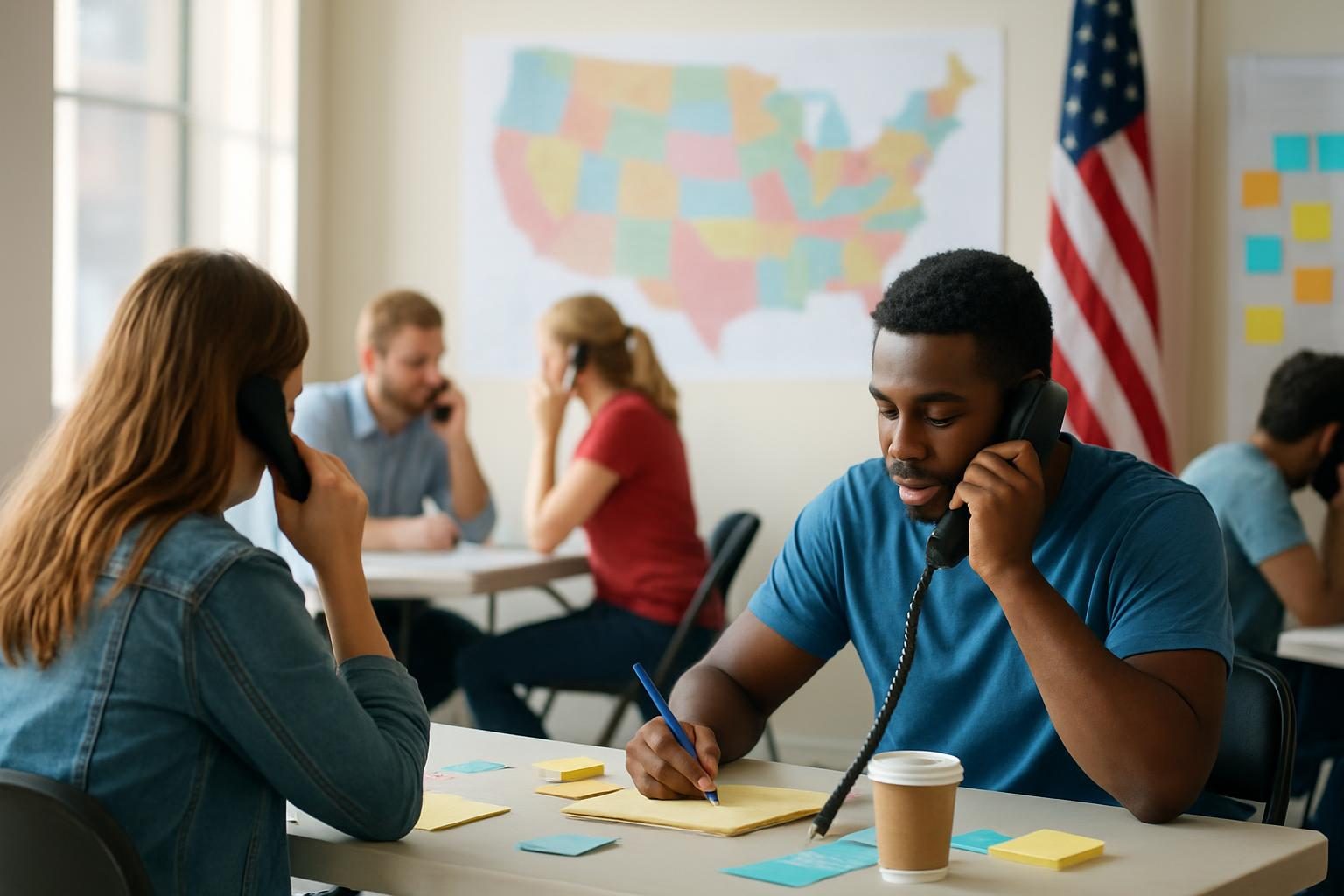
Step 1: Pick the race (and the cause) that moves you
You do not need to start with the presidency. Some of the highest-impact work happens in races you may never see on cable news: a state legislative seat, a county office, a school board contest, a ballot measure on climate policy, or other local ballot measures.
Ask yourself three questions:
- What issue gets you fired up? Health care, the economy, voting rights, education, climate. Our explainer on where Democrats stand on the big issues can help you sort out your priorities.
- Which race is closest to home? Local and state races often have small teams, so a single volunteer can make a visible difference.
- Which candidate or organization shares your values? Read their website, their record and their platform before you sign up.
Where to look
Start with your candidate’s official website and look for a “volunteer” or “get involved” page. Then check in with your county or state Democratic Party organization, which often coordinates volunteers across many races at once. If you are not sure who will be on your ballot, your state or local election office can tell you.
If you want to go beyond one campaign, our guide to getting involved in politics locally, no run needed has more ideas.
Voting is the minimum. Volunteering is how you help everyone else do it too.
Step 2: Choose a role that fits your life
Campaigns need far more than people who enjoy knocking on doors. Whatever your personality or schedule, there is probably a job for you.
| Role | What you do | Good fit if you… |
|---|---|---|
| Canvassing | Talk to voters at their doors using a script and a list | Like being outdoors and meeting people |
| Phone banking | Call voters from home or a campaign office | Prefer conversations without the walking |
| Text banking | Send and answer messages to voters | Want a flexible, low-pressure option |
| Data entry | Log voter responses and keep lists accurate | Are detail-oriented and like working behind the scenes |
| Voter registration | Help eligible neighbors register or check their status | Care about expanding participation |
| Event help | Set up, greet, hand out materials, run sign-in tables | Enjoy being part of a crowd and a team |
| Hosting | Open your home or a local space for a house party or meeting | Have a welcoming space and a wide circle of friends |
Not sure? Tell the volunteer coordinator what you like doing and what time you have. Good coordinators love that question and will point you somewhere useful.
Step 3: Sign up and show up for your first shift
Your first shift is easier than you think. Most campaigns give new volunteers a short training, a script and often a partner. Nobody expects you to be an expert on every policy detail.
What to expect
- A quick orientation. You will learn the candidate’s key messages and how to log what voters tell you.
- A script and a goal. The point is usually to listen, share a few key points, and note where a voter stands.
- Someone to ask. If a voter has a question you cannot answer, say so and note it. Honesty builds trust.
Tips for a good first shift
- Wear comfortable shoes, bring water and charge your phone.
- Go with a friend if the campaign allows it.
- Listen more than you talk. People remember being heard.
- Thank everyone, including people who disagree with you.
- Follow the campaign’s safety guidance and step away if a situation feels uncomfortable.
Take action: Open a new tab right now and look up one candidate on your ballot. Find their volunteer page, sign up for one shift this month, and send a friend the link so you can go together.

Help people register and vote
One of the most valuable things a volunteer can do has nothing to do with persuasion: helping people take part. A neighbor who is not sure if they are registered, a college student who just moved, a first-time voter who does not know where to start. These are people you can help in minutes.
Every state’s official rules, deadlines and online registration links are on vote.gov, which has a page for each state (swap in your state’s name at the end of the web address). North Dakota is the one state with no voter registration. Many states offer same-day registration, but the rules differ, so always confirm the details on vote.gov or with your state election office rather than relying on word of mouth.
Want a plain-language walkthrough you can share? Send people to our simple guide to registering to vote in every state.
Why this is about more than one election
Here is our view: the strongest argument for volunteering is that it builds something that lasts. A campaign ends. The relationships, the lists, the trained volunteers and the local habit of showing up do not have to.
That matters because many of the rules that shape elections are decided in places most voters rarely look. Legislative district lines, for example, determine whose votes carry weight for a decade. Our explainer on how gerrymandering decides elections shows why state-level races deserve volunteers too. And the history of the Voting Rights Act is a reminder that access to the ballot was won by people who organized, marched and knocked on doors.
Volunteers have also powered past waves. If you want the history, read about the 2018 blue wave and what Democrats learned and the broader story of wave elections.
A campaign ends. The neighbors you meet and the habit of showing up can last for years.

The strongest arguments against volunteering (and our response)
Not everyone is convinced that volunteering is worth the time. Here are the most common objections, stated fairly, with our answers.
“My single effort won’t change anything.”
It is true that one volunteer will not decide a major election. But campaigns are built from many individual efforts that add up, and local races can turn on small numbers of voters. The honest framing is that your contribution is real but shared, like a vote that counts alongside millions of others.
“Politics is too divisive; I would rather stay out of it.”
This is a fair feeling, and plenty of thoughtful people share it. Our response is that the alternative to participation is not peace, it is leaving decisions to whoever shows up. Respectful conversation on a doorstep is one of the best antidotes to polarization, not a cause of it.
“Campaigns waste volunteer time or rely on free labor.”
Some do, and critics are right that a disorganized operation can burn people out. That is a reason to choose well and to ask questions: what will I be doing, how will it be used, and who will support me? Good campaigns value volunteers and treat their time with respect.
“Canvassing and calls are less effective than ads.”
Reasonable people debate the best mix of tactics, and we will not pretend to settle it with statistics here. What we can say is that campaigns of every kind still invest heavily in direct voter contact, and that personal conversations also help people register, check their polling place and make a plan to vote, things an ad cannot do.
“I disagree with this party or candidate.”
Then volunteer for the cause or the candidate you do believe in, or for a nonpartisan voter help effort. Our site leans progressive and we encourage you to get involved on the blue side, but the core idea is simple: a democracy is stronger when more people take part.
Looking ahead: 2028 and beyond
The next presidential election is on Tuesday, November 7, 2028, and the Democratic early primary window is already set, starting with South Carolina on January 22, 2028. As of October 2026, no major Democrat has formally declared a run, so the field is still wide open. You can follow the tracker of potential 2028 Democratic candidates and the full 2028 Democratic primary calendar as things develop.
The best time to build the skills and relationships that win in 2028 is now. Volunteering this fall teaches you how a campaign actually works, and it connects you to the people who will organize the next big race. And if volunteering stirs bigger ambitions, we are working on a guide on how to run for local office.
Keep exploring the issues that bring people to campaigns, from health care to the economy, and browse more in our Issues & Ideas section. For the full roadmap, start at our 2028 presidential election hub.
Key takeaways
- Volunteering is open to almost anyone, and campaigns usually train you on your first shift.
- Start with a race or cause you care about, then contact the campaign or your local Democratic Party organization.
- There are roles for every personality: canvassing, calls, texts, data, events, hosting and voter registration help.
- Helping neighbors register and vote is one of the most valuable things you can do. Always send people to vote.gov or their state election office for rules and deadlines.
- The 2026 midterms are on November 3, 2026, so the next few weeks matter, and the work carries into 2028.
- Honest objections to volunteering exist, and the best answer is to choose a well-run effort and start small.
Last updated October 2026. Dates and candidate news change fast; we update this page as things are announced.
Frequently asked questions
Do I need experience to volunteer for a campaign?
No. Most campaigns train new volunteers on the spot, usually with a script, a shift partner and a short orientation. If you can show up, follow a simple plan and be friendly, you can help. Tell the volunteer coordinator what you enjoy and they will match you to a role.
How much time do I have to give?
It is up to you. Some people give a couple of hours on a weekend, others commit to a weekly shift, and some take on bigger leadership roles as the election gets closer. Campaigns generally prefer a reliable small commitment over a big promise that falls through.
Can I volunteer if I am not registered to vote or cannot vote?
Rules about who can volunteer vary by campaign and by state, so ask the campaign directly. If you are eligible to vote and not yet registered, check your state’s rules and deadlines at vote.gov or with your state election office. Many campaigns also help volunteers and neighbors with registration.
How do I find a campaign to volunteer for?
Start with your local Democratic Party organization, your candidates’ official websites, and the groups already organizing in your community. Look for a volunteer or get-involved page and sign up. If you are not sure who is on your ballot, your state or local election office can tell you.
Is it safe to volunteer, and what if I get a hostile reaction?
Most conversations are polite, even when people disagree. Campaigns usually train volunteers to stay calm, thank people for their time and move on from a bad exchange. Canvass with a partner when you can, follow your campaign’s safety guidance, and leave any situation that feels uncomfortable.